
Homeland:
Exploring Belonging Amidst Occupation
Homeland is a multimedia immersive installation that invites
visitors to explore the way in which Western media portrays Palestine, gain a
deeper understanding of Israel’s historical and ongoing occupation of
Palestine, and reflect on their own interpretation of home.
The creation of this capstone project was a year long process of research and development from August 2024 through April 2025. It was designed to occupy Chatham University's Mellon Center dining room and solarium, where it was installed April 16-23 2025.
The creation of this capstone project was a year long process of research and development from August 2024 through April 2025. It was designed to occupy Chatham University's Mellon Center dining room and solarium, where it was installed April 16-23 2025.
Press the play button above to experience Homeland - An Archive
The installation contained three major elements:
Remnants, an Immersive Film

The immersive film Remnants
emerged as a way to educationally and artistically engage
visitors with the exhibit’s topic of Palestine’s historical and ongoing occupation. It is a five
minute video that plays on a loop.
Homeland, an Interactive Projection Wall

This piece was developed mainly using
TouchDesigner, a visual programming
environment aimed at the creation of multimedia applications. Microsoft’s Azure
Kinect, which captures depth and body
tracking data, was used with overlapping visuals manage opacities and windows
through the front layers.
Reflections, a Collaborative Collage
![]()
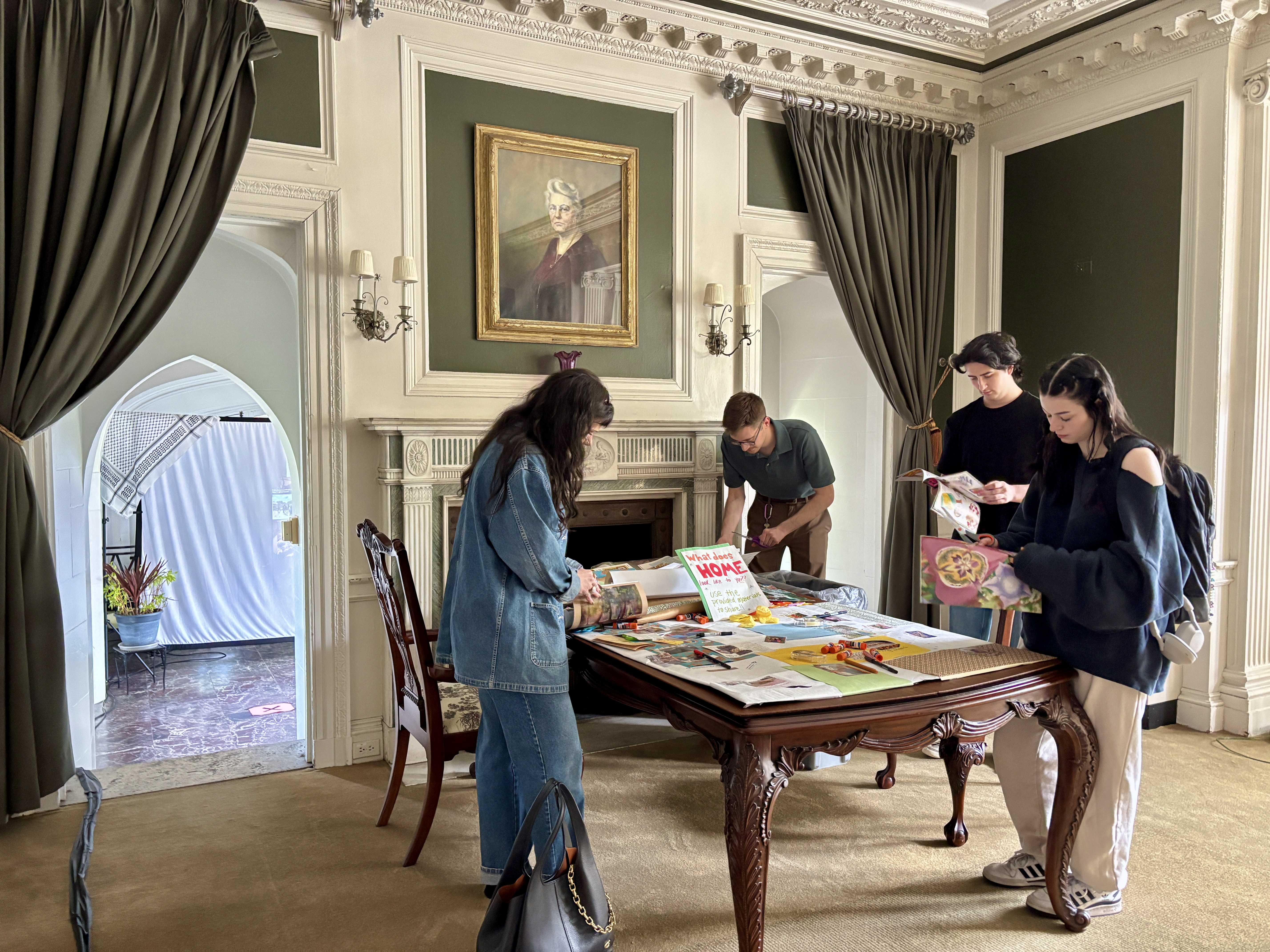
It was important for this
installation to have a participatory art experience where visitors could
reflect on their own understandings of home and connect with visitors from any other point during the installation.
Collage emerged as a major theme of
Homeland existing through its ideation and concepts, through its sound,
space, and participatory art experience. Collage became the process in which
Homeland was both created and experienced. Collage requires you to take a
closer look, in order to understand its meaning, content, and the
bigger picture. This idea of stepping in to understand the larger narrative
emerges within the main digital interactions.
Collage as a process of deconstruction and reconstruction also resonates with the destruction within Palestine, yet its capacity to continue to exist as a home.
This installation aimed to contrast typical western media that frames Palestine in their tragedy and occupation. It encourages visitors to "take a closer look" at the nation of Palestine to see their stories, culture, celebrations, and resistance.
Collage as a process of deconstruction and reconstruction also resonates with the destruction within Palestine, yet its capacity to continue to exist as a home.
This installation aimed to contrast typical western media that frames Palestine in their tragedy and occupation. It encourages visitors to "take a closer look" at the nation of Palestine to see their stories, culture, celebrations, and resistance.

I created the above collage using
inspiration and reference imagery, to not only begin to understand the desired
visual outcomes, but also consider adjacencies within the sections of the
whole experience.